
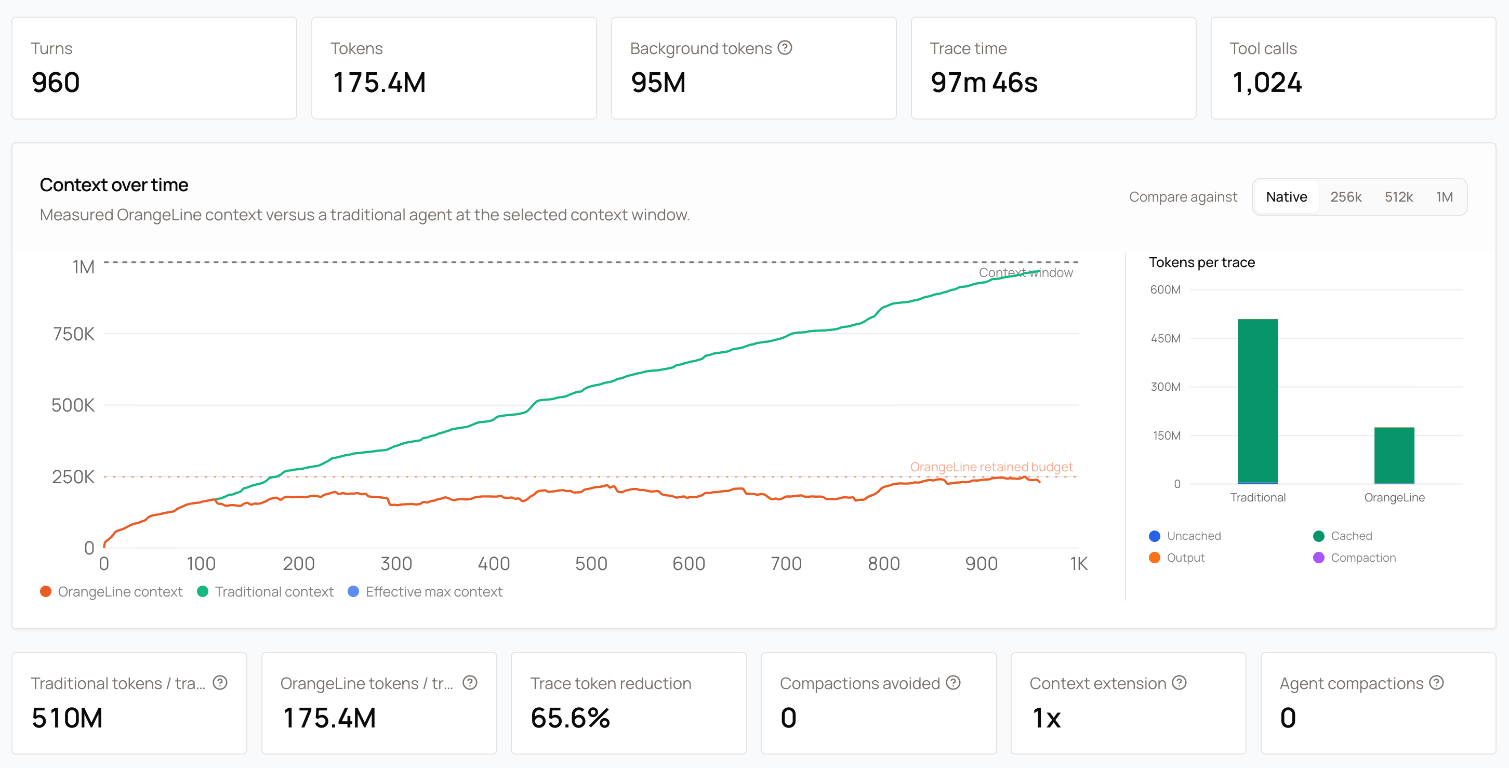
Context growth for a single session in the conversations page. Session affinity keeps follow-up requests on the GPU that holds the conversation's KV cache, so cached context accumulates instead of being re-sent.
Custom agent applications
Pick a header name that names your application, ending in-session-id and starting with x-. For example, an integration built on LangChain could send:
x-<name>-session-id is accepted, as long as the name is not reserved (see Headers to avoid). The gateway treats it as your session identity.
The <name> part also becomes the agent label shown next to your conversations in usage views, so x-langchain-session-id shows as langchain. Pick the name your users should see. Use lowercase letters, digits, hyphens, and underscores. Values are lowercased before they are stored.
Follow these rules for the value:
- Mint a fresh value when a conversation starts, such as a UUID. Do not reuse values across conversations.
- Send the same value on every request that belongs to that conversation, including retries and tool-loop turns.
- Keep the value between 8 and 256 characters. Shorter or longer values are ignored.
- The header is read before any protocol translation, so it works the same on
/v1/chat/completions,/v1/messages, and/v1/responses.
x-client-request-id alongside the session header. It identifies a single request, not a conversation.
Subagents
An agent that spawns a subagent sends two independent streams of requests. The subagent starts with its own system prompt and its own history, so it cannot reuse the parent session header. Without a nest signal the gateway records the subagent as a separate top-level conversation. Give each spawned subagent its own session id, and name the parent’s. The parent header must use the same<name> as the session header. A parent header whose <name> does not match the session header is ignored.
- Give each spawned subagent a fresh session id of its own. Never reuse the parent’s session id for a child.
- The parent value is the parent’s session id exactly as the parent sends it. Do not transform it.
- Point at the conversation that directly spawned the subagent, not at the root of the whole run. A subagent of a subagent names its immediate parent.
- The link fills in on a later request if the subagent’s first request arrives before its parent has sent anything.

Subagent sessions for one conversation. Each row is a subagent conversation with its own model, request count, tool calls, and token usage.
Headerless session affinity
When you are unable to provide a session header like above for some reason, our gateway will use prefix hash and other heuristic measures to attempt to correlate requests into a session. This is generally quite reliable, but it requires more DB and cache lookups to serve inference, which can lead to a slight decrease in throughput. For this reason, we recommend providing a consistent header format to optimize your end-user experience.Coding agents
Coding agents like Claude Code, Codex, OpenCode, and Pi natively send out session ids for long running workloads, so this session affinity should work out of the box. We recommend using these agents in context with our CLI to enhance the experience. This will make it easier to auto-discover model capabilities and route inference requests to our servers.Headers to avoid
These header names are reserved for specific clients or for internal gateway routing. Sending them from a custom application does not have officially supported behavior. Request grouping and cache-aware routing may still work, but conversations may be misidentified as coming from a particular coding agent.
The rule is simple: use one
x-<your-app>-session-id header of your own, and send nothing from the list above.
prompt_cache_key
prompt_cache_key is an optional request field on /v1/chat/completions and /v1/responses, not a header. It can be used as a fallback for routing session affinity when no headers are present. We recommend using a session header instead.